
Angus Taylor Is Not the Answer
Nation First explains why Angus Taylor represents continuity, not renewal, and cannot rebuild the Liberal base.
Dear friend,
The following article first ran in my other publication ConfidentialDaily.com yesterday:
Every time the Liberal Party collapses into crisis, a familiar ritual begins. The insiders whisper about a “safe pair of hands”. The commentators float a “serious economic mind”. The establishment rallies behind a man they insist can restore order.
This time, that man is Angus Taylor.
But scratch beneath the surface and the myth collapses quickly. Taylor is not a reset. He is not a revival. He is not even a risk. He is continuity dressed up as renewal, the managerial face of a political class that has already failed.
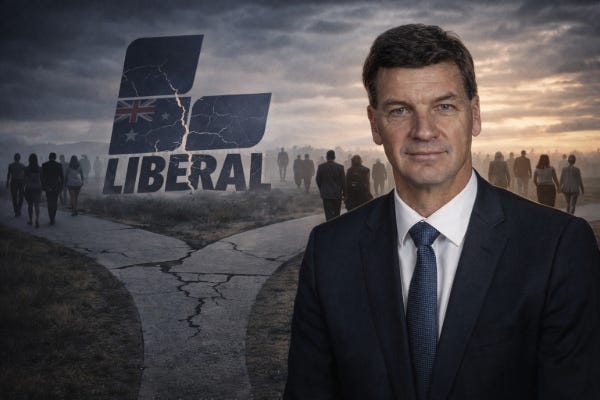


Angus Taylor is not a fresh start; he is the polished face of a failed political class, repackaged to manage decline rather than reverse it.
His rise reflects elite grooming, not grassroots conviction: McKinsey, Oxford, and backroom advisory roles, not a record of fighting for working Australians.
As Energy Minister, he entrenched net zero orthodoxy, binding Australia to global climate frameworks conservatives reject, while offering spin instead of substance.
On COVID, he nodded through lockdowns and praised AstraZeneca, showing loyalty to the system over the people, silence and compliance where leadership was needed.
His cautious language on immigration, limp economic messaging, and self-congratulatory Facebook blunder reveal a politician lacking the fire, clarity, and courage to lead a revival.

Angus Taylor’s story is not the story of grassroots conservatism. It is the story of elite formation. King’s College Parramatta. Rhodes Scholar at Oxford. Partner at McKinsey, the corporate bureaucracy famous for managing systems, not leading movements. A career advising governments and global institutions, not fighting for ordinary Australians.
This matters. Because the Liberal Party’s crisis is not technical. It is cultural and political. The party did not lose voters because it lacked spreadsheets. It lost voters because it lost conviction, clarity, and courage. Replacing one managerial figure with another does not rebuild a base. It confirms the base was never understood in the first place.
Taylor’s defenders say he is a conservative. The record tells a more complicated story. As Energy and Emissions Reduction Minister, he embedded Australia deeper into the architecture of net zero, endorsing a 2050 target and advancing the long-term emissions reduction framework. This was dressed in the language of “technology not taxes”, but the practical effect was the same. It bound Australia to the global climate policy structure and normalised the very framework many conservative voters reject.
For a party trying to reconnect with working families struggling with power prices and economic insecurity, this is not trivial. It signals alignment with the same policy consensus that voters believe has already failed them.
Then came COVID. Taylor was not the loudest voice during that era, but he stood beside Scott Morrison, who was endorsing the logic of lockdown compliance. Literally. As Morrison declared support for lockdowns and vaccines at press conferences, Angus stood alongside him and nodded. And no wonder. This was the language of managerial governance. Along with that, Angus did indeed praise the dangerous AstraZeneca vaccine. But for the most part, he didn’t say much about COVID overreach. For a large section of conservative voters who felt abandoned during that period, silence and acquiescence still carry political weight.
On immigration, Taylor again reveals the instincts of a technocrat rather than a political leader. He emphasises Australia as a “proud immigrant nation” and speaks in percentage reductions rather than firm caps. The language is cautious, calibrated, and careful. But politics is not an economics seminar. Voters who believe migration levels are too high are not looking for calibration. They are looking for clarity.
The same pattern repeats in his performance as economic spokesman. When the Coalition needed a compelling economic narrative, it produced little more than bureaucratic restraint and thin policy. Even internal critics noted the lack of boldness. If Taylor could not define the economic fight from opposition, why should anyone believe he can redefine the party from a position of leadership?
There is also a revealing glimpse into Taylor’s political instincts that many voters will remember. During the 2019 election campaign, he accidentally posted praise to his own Facebook page (presumably because he had a fake account he was meant to post it from), congratulating himself for his own announcement. The episode was quickly deleted, but the symbolism lingered. A politician speaking to himself rather than listening to others is not the image of a leader rebuilding a movement.
And then there is the question of political instinct more broadly. The “TACO” label circulating within Liberal ranks, Taylor Always Chickens Out, is not just factional cruelty. It reflects a deeper perception of hesitation and caution. Leadership, particularly in a broken party, demands decisiveness. The current moment is not a management challenge. It is a political confrontation. Caution rarely inspires revival.
The deeper problem is this. Taylor represents the same governing class that presided over the party’s decline. A technocratic elite, comfortable with global frameworks, cautious on cultural fault lines, managerial in crisis, and distant from the grassroots. Installing him as leader would not mark a new chapter. It would confirm the same story continues.
Nor is Sussan Ley the answer. The crisis of the Liberal Party is bigger than personalities. It is a crisis of identity. Voters do not know what the party stands for, and too often, neither does the party itself. Swapping one establishment figure for another does not solve that problem.
The Liberal Party does not need a manager. It needs a conviction politician who understands why voters walked away. It needs clarity on energy, sovereignty, migration, and civil liberty. It needs a connection with the base, not comfort within the system.
Angus Taylor may be a capable administrator. He may be intelligent, disciplined, and experienced. But the moment demands more than competence. It demands renewal.
And continuity, no matter how polished, is not renewal.
Until next time, God bless you, your family and nation.
Take care,
George Christensen

George Christensen is a former Australian politician, a Christian, freedom lover, conservative, blogger, podcaster, journalist and theologian. He has been feted by the Epoch Times as a “champion of human rights” and his writings have been praised by Infowars’ Alex Jones as “excellent and informative”.
George believes Nation First will be an essential part of the ongoing fight for freedom:
“The time is now for every proud patriot to step to the fore and fight for our freedom, sovereignty and way of life. Information is a key tool in any battle and the Nation First newsletter will be a valuable tool in the battle for the future of the West.”
— George Christensen.
Find more about George at his www.georgechristensen.com.au website.
I have more questions than answers. Are they reading the room? Do the LNP realise Australians are crying out for a genuine alternative to leftist Labor? Or are they so controlled by the ‘powers behind the power’ that they couldn’t be that alternative if they wanted?
What's this bloke 'think' he's going to do?, nothing, that's what, except, continue robbing the tax payer with his eye watering expenses and salary. One Nation are not going to pull any rabbits out of a hat neither. Wait and see if i'm wrong, and, i'm a One Nation supporter.