

West Repeating Rome's Fatal Collapse
Nation First reports on the striking parallels between the modern West and the dying Roman Empire.
Dear friend,
A highly polarised society where ordinary people are squeezed by rising taxes and the cost of living, while their elites live in their own sheltered bubble, enjoying a detached, gilded existence. Borders are no longer secure as foreigners flood in, don’t integrate, and are slowly carving out their ethnic enclaves. This does not bother the government, which is more preoccupied with ideological victories over its opponents rather than addressing the worsening crisis.
This is something that could just as easily be said about the current West as about the last century of Rome. Powerful civilisations that have lasted centuries do not decline from external threats alone; they often succumb to internal rot that weakens them from within first.
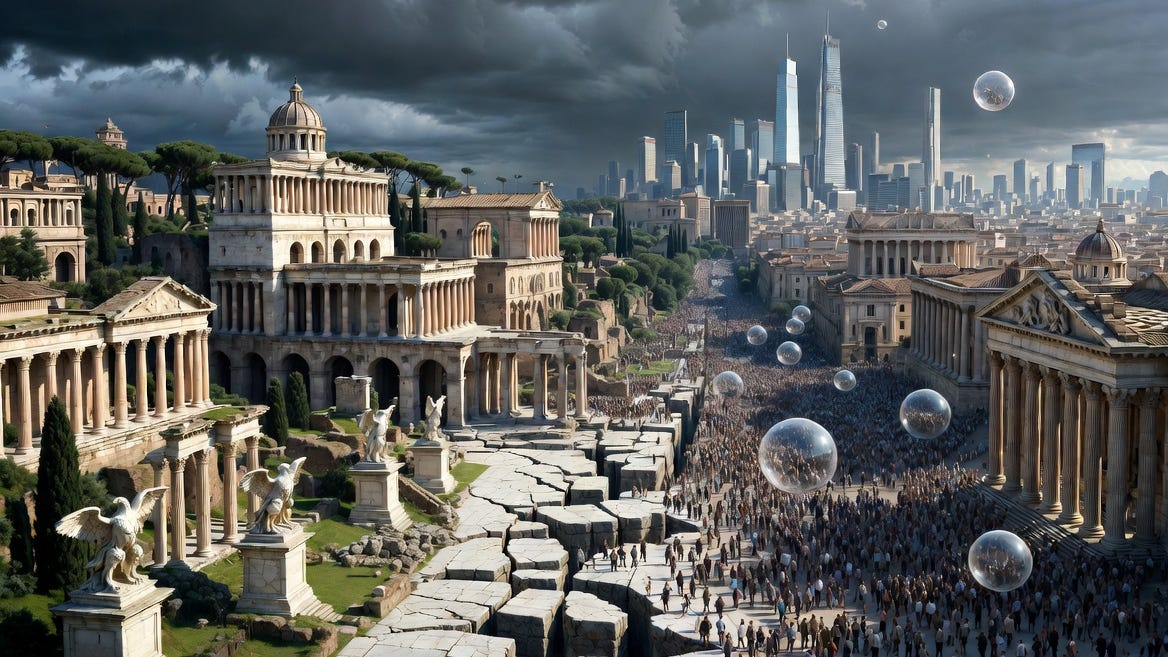


A deeply polarised society sees ordinary citizens crushed by rising taxes and living costs while detached elites enjoy a gilded existence in their protected bubble.
Insecure borders allow mass immigration and ethnic enclaves to form as governments prioritise ideological battles over addressing the growing crisis.
Powerful civilisations like Rome and the 20th-century West once triumphed through strong civic spirit and collective sacrifice, but that vital resolve has now faded.
Despite superior wealth, technology, and military hardware, the modern West suffers from internal rot, complacency, and lost cohesion that weakens it against even weaker opponents.
Burdened populations may eventually welcome external disruption when they no longer view their own system as a shared civilisation worth defending.

Early in Roman history, in its war against Carthage, the Romans would lose entire armies, only for more of its citizens to volunteer and fill the ranks. This collective resolve led the Romans to triumph over their enemies, a population that placed personal sacrifice above individual comfort to preserve the nation as a whole.
It is also why the early and mid-20th-century West was capable of such extraordinary collective mobilisation in moments of existential crisis. Think of the generation that fought during the World Wars and how they returned home and committed themselves to rebuilding their nations with a disciplined sense of duty and restraint, prioritizing national recovery above personal gain.
That kind of civic spirit is increasingly absent in the modern West, particularly among its leadership class. The same decay marked late Rome. Its population had become complacent, atomised, and driven by private gains over public responsibility.
By numbers and wealth, late Rome was a far more powerful state than it had been centuries earlier. However, its people lacked the same pride and spirit they once had. Generals backstabbed each other, soldiers would easily panic and retreat, and even the emperor’s personal guards would assassinate him if another contender promised them higher pay. This is why late Rome struggled against much weaker enemies, just as we, in the modern West, now fail to achieve military objectives against far weaker foes.
Physically, with our massive fleets, professional armies, control of tech and finance, and advanced infrastructure, the Western world still resembles an unmatched civilisational structure. But beneath that surface, the spirit and cohesion that once gave that power meaning and direction are steadily thinning. But internally, the spirit and cohesion that hold a civilization together are disappearing. We are isolated souls just existing inside a system that no longer recognises itself as a shared civilisation, no longer capable of articulating what it is, or what it exists to preserve.
Such a society quickly unravels under sustained pressure.
I remember reading accounts that, in various parts of the former Empire, ordinary people actually welcomed barbarian rule. So burdened had they been with taxes, instability, and the moral contradictions of their elites that they saw the Empire not as a home or identity worth defending, but as a machine imposed over them that kept them miserable.
Let us strive for a future where our Western world does not follow the same trajectory, and where future generations come to value, strengthen, and defend their identity rather than abandon or resent it.
Until next time, God bless you, your family and nation.
Take care,
A Nation First Staff Writer

George Christensen is a former Australian politician, a Christian, freedom lover, conservative, blogger, podcaster, journalist and theologian. He has been feted by the Epoch Times as a “champion of human rights” and his writings have been praised by Infowars’ Alex Jones as “excellent and informative”.
George believes Nation First will be an essential part of the ongoing fight for freedom:
“The time is now for every proud patriot to step to the fore and fight for our freedom, sovereignty and way of life. Information is a key tool in any battle and the Nation First newsletter will be a valuable tool in the battle for the future of the West.”
— George Christensen.
Find more about George at his www.georgechristensen.com.au website.
When your "leaders", you know those that swore a solemn vow to serve and defend their country, have become traitors and are working with your enemy to destroy your country, and there is no way to rid yourself of these psychos because fair and democratic elections don't work anymore, then there is only one option remaining, it's what most don't want to consider or name, the cost is too great, but America had to make the terrible choice, to sacrifice so many to break the chains of bondage, can we dare to do the same, for the freedom of our future generations?
MAGFA! Make Australia Great and Free Again!
Out of all that chaos came a book that has been the antidote. City of God by St Augustine speak to our moment if we will read.