

AI’s Noisy, Thirsty Takeover
Nation First looks into the noise, water consumption and hidden costs of Australia’s $150 billion AI data centre boom.
Dear friend,
New data centres are popping up everywhere in Australia.
Just outside of Melbourne, a $1.1 billion mega data centre is being proposed, covering an area almost six times the size of Chadstone Shopping Centre.
The Northern Territory has also awarded 457 acres of land near its capital, Darwin, for a proposed data centre.
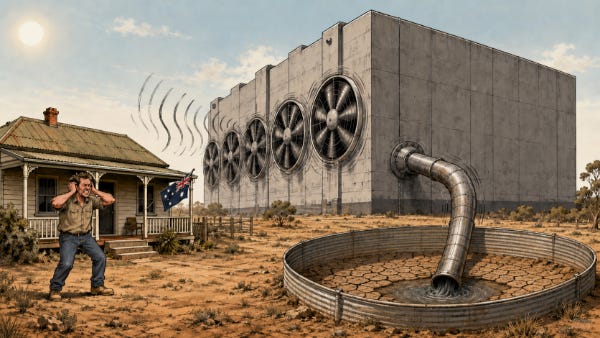


Massive data centres are being constructed across Australia with little regard for nearby communities.
Residents can face relentless noise from cooling systems, generators and industrial equipment.
Water-hungry data centres make little sense on the world’s driest inhabited continent.
These facilities can strain electricity grids while delivering surprisingly few permanent local jobs.
Multinational corporations collect the profits while Australian communities bear the costs.
Almost every State and Territory has been caught up in this AI data centre building frenzy, with Australia’s data centre investment pipeline now estimated at more than $150 billion. And that figure could easily rise further given the track record of major infrastructure projects exceeding their original budgets.
But residents in affected neighbourhoods are rightly fighting back. Data centres aren’t just an eyesore but also a health hazard to nearby residents. They are extremely loud, generating a relentless hum of countless cooling systems, generators, and other equipment, day and night.

Humans are meant to spend much of their day in a reasonably peaceful environment. Prolonged exposure to loud noise has been linked to sleep disruption, chronic stress, impaired concentration, hypertension, cardiovascular disease, and accelerated ageing.
But in the case of Australia, the world’s driest inhabited continent, there is another issue: water. Many parts of Australia are running out of easily accessible clean water. Some of our smaller towns are already preparing for the possibility that their water supplies could fail, and the residents will have to abandon their homes altogether.
Small farmers, many already burdened with heavy debt, now have to leave land unplanted during some seasons because enough water just isn’t available. Drought can slash farm incomes, increase operating costs, and leave smaller farms with little room to absorb another bad season.
It is in this context that building numerous new data centres starts to seem absurd in an already water-stressed nation.
A data centre consumes a lot of water; about 19 megalitres a day. This is water being siphoned away from farms, local industry, and households.
And of course, these centres use enormous amounts of electricity, which can also place pressure on local power systems and prices.
All those tens of billions of dollars invested, neighbourhoods disrupted, higher utility bills handed out, and precious water consumed – all so we can participate in what increasingly looks like an AI infrastructure bubble.
These data centres only offer temporary benefits to locals through short-term construction spending, temporary employment, and tax or infrastructure deals. Once construction is finished, however, data centres can employ surprisingly few permanent workers, often fewer than 100, while much of the specialised work and spending comes from outside the local area.
The real beneficiaries of all these new AI centres would be the oligarchs and international corporations who own them.
To them, a data centre is effectively a giant piece of income-producing real estate. Once built, they lease the facility to a technology company under a long-term contract. The tech company gets the computing capacity it needs to train and operate increasingly powerful AI systems capable of mass surveillance, and the investors get a predictable stream of payments and an asset that can appreciate in value.
A few international elites get to reap all the profit while Australian citizens are left to contend with the costs imposed by these data centres.
Until next time, God bless you, your family and nation.
Take care,
A Nation First Staff Writer

George Christensen is a former Australian politician, a Christian, freedom lover, conservative, blogger, podcaster, journalist and theologian. He has been feted by the Epoch Times as a “champion of human rights” and his writings have been praised by Infowars’ Alex Jones as “excellent and informative”.
George believes Nation First will be an essential part of the ongoing fight for freedom:
“The time is now for every proud patriot to step to the fore and fight for our freedom, sovereignty and way of life. Information is a key tool in any battle and the Nation First newsletter will be a valuable tool in the battle for the future of the West.”
— George Christensen.
Find more about George at his www.georgechristensen.com.au website.
NOTE: Due to the large volume of emails I receive, it is not possible to email me and ask to be unsubscribed from this newsletter. You must do it yourself by following the simple processes listed below: